
 EN
EN  ID
ID Author: Kayika (Research & Media Advocacy, Savy Amira WCC)
The May 1998 Reflective Discussion brought together four prominent speakers to engage in dialogue on how society responds to the history of the May 1998 riots, particularly in relation to intimidation, racial discrimination, violence against women, and military operations that began to intrude into civilian spaces. The speakers were Sondang Frishka Simanjuntak (Chair of Komnas Perempuan, 2025–2030), Evi Lina Sutrisno (Lecturer at FISIPOL UGM and researcher on the May 1998 riots in Surabaya), Ita Fatia Nadia (Board Member of Amnesty International Indonesia and companion to survivors of the May 1998 Tragedy), and Amira Paripurna (Lecturer at the Faculty of Law, Airlangga University).
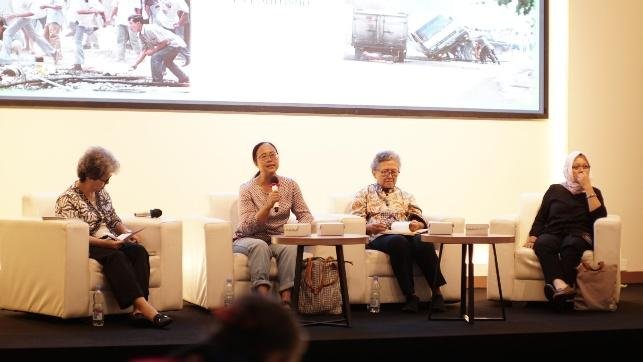
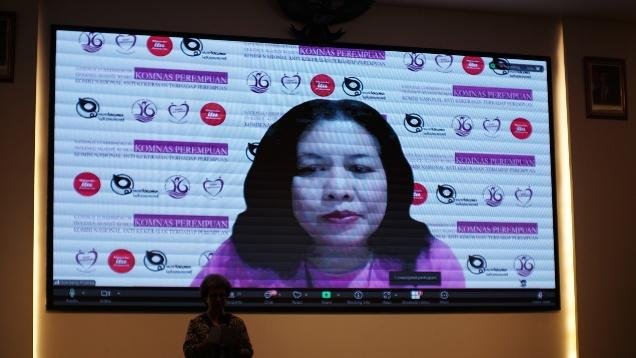
This discussion, collaboratively organized by KSGK UBAYA, Savy Amira WCC, and the Wiloka Society Peer Group of the Faculty of Psychology UBAYA , served as an important effort to preserve collective memory of struggles against injustice and various forms of violence experienced by women and marginalized groups. It also symbolized the importance of safe spaces in nurturing civic movements that care about historical truth, challenge misleading narratives, and bridge knowledge gaps surrounding the events of May 1998. Due to the lack of transparent, survivor-centered historical documentation in Indonesia—and the limited discussion of May 1998 in school curricula—this history must be shared more openly, especially with young people who will carry forward the collective responsibility of safeguarding democracy and resisting all forms of violence.
The discussion opened with the screening of the documentary HOTLINE 1998, which recounts the experiences of humanitarian volunteers involved in an emergency hotline established to respond to mass rape during the May 1998 riots. The film highlights the challenges of assisting survivors—most of whom were Chinese Indonesian women—and emphasizes that mass rape was a real and extreme form of sexual violence. Families of survivors, together with human rights defenders, demanded that the government acknowledge the violence and take responsibility rather than deny the evidence presented.
The panel session began with an explanation of Komnas Perempuan’s role in advocating for justice and recovery for survivors of the May 1998 violence. Sondang Frishka Simanjuntak explained that Komnas Perempuan was established following strong demands from civil society to accompany women survivors in the aftermath of the riots. She outlined four key survivor rights: the right to truth, justice, recovery, and guarantees of non-repetition. Komnas Perempuan has consistently pushed the government to address May 1998 as a gross human rights violation, urged follow-up on Komnas HAM’s findings, advocated for legal and policy reforms, and strengthened witness and survivor protection mechanisms. The institution has also engaged in ongoing dialogue and solidarity actions with survivors’ families through various memorialization and advocacy initiatives.
Evi Lina Sutrisno traced the long history of racial violence and discrimination against Chinese Indonesians, noting that anti-Chinese sentiment did not emerge suddenly in May 1998 but dates back to colonial-era racial segregation policies under the Dutch VOC. During the New Order regime, discriminatory policies restricted Chinese Indonesians’ access to public life, forcing many into small-scale commerce while erasing their cultural expressions, including through administrative requirements such as the SBKRI. During the May 1998 riots in Surabaya, violence targeted several areas of the city, and reports of sexual violence were documented by religious leaders. While 15 rape survivors were identified, the actual number is believed to be higher due to trauma, stigma, and risks of enforced disappearance.
Historian Ita Fatia Nadia discussed the links between militarism and violence against women, criticizing attempts to produce a so-called “official history” that erases survivors’ experiences. She emphasized that state denial of mass rape in May 1998 reflects a broader refusal to take responsibility for past violence. Ita warned of the dangers of rising militarism and fascism, stressing that women are often the first targets of state violence. She highlighted how patriarchal and militaristic systems reinforce gender hierarchies and oligarchic power, and reminded the audience that truth-tellers—including child survivor Fransiska (11) and activist Ita Martadinata (18)—have historically faced lethal risks.
From a legal perspective, Amira Paripurna raised concerns about the revision of the Indonesian Armed Forces Law (UU TNI), which could enable military operations in civilian spaces without adequate democratic oversight. She warned that such changes risk undermining checks and balances, threatening civil liberties, digital democracy, and freedom of expression. Human rights defenders may increasingly be labeled as ideological threats, foreign agents, or radicals, creating conditions for intimidation, abuse of power, and the silencing of critical voices.
The discussion concluded with strategic recommendations emphasizing the importance of maintaining collective memory to prevent the repetition of past violence. The speakers underscored the need to strengthen civil and student movements, promote inclusive and intersectional historical narratives, foster peer-based political education, and cultivate spaces of inter-ethnic dialogue grounded in tolerance.
Readers are invited to access the full materials from the May 1998 Reflective Discussion through bit.ly/materi24mei2025and to contribute suggestions for May 1998 historical memorabilia via bit.ly/memorabiliamei98.