
 EN
 ID
Author: Eka Wulan Sari (Intern from Muhammadiyah University of Malang)
Savy Amira, in collaboration with the Wiloka Society Peer Group in Social Psychology at the Faculty of Psychology, Universitas Surabaya, and Hope Helps ITS and supported by the dating app platform OMI hosted a talk show titled “Maintaining a Safe Space for Women in the Digital Realm: Recognizing and Combating AI-Based Love Scams in the World of Online Dating.” The hybrid event, held on Sunday, September 20, took place in person at the Multipurpose Room of the Faculty of Psychology at UBAYA, Jl. Kalirungkut, Tenggilis Mejoyo, Surabaya. This talk show was organized amid growing concerns over the rise of AI-based love scams on dating apps. Women are among the groups most vulnerable to these scams. In addition to the potential for financial loss, there are also psychological impacts of love scams that are often overlooked. Through this event, participants were encouraged to understand how love scams occur and to recognize the evolving tactics behind them amid advancements in artificial intelligence (AI) technology in the world of online dating.
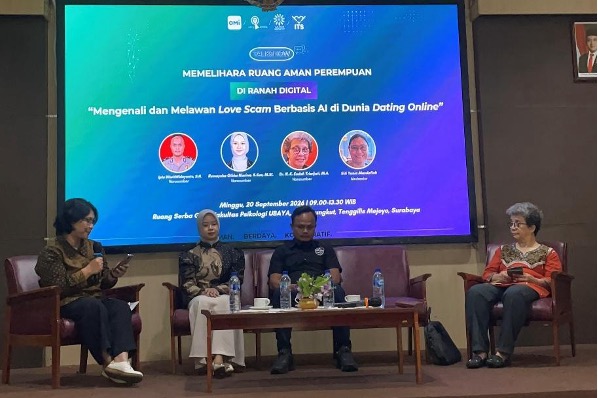
This talk show featured three panelists and was attended by approximately 60 participants. The event began with opening remarks from Savy Amira Chairwoman Siti Mazdafiah and Lukas Ling, a representative of the dating app platform OMI. Following the opening remarks, the event continued with the main talk show session, which began with an introduction of the moderator and the three panelists. The discussion session was moderated by Siti Yunia Mazdafiah, Chair of Savy Amira. The discussion began with perspectives on victims’ experiences and vulnerability to love scams, followed by a discussion of digital security and steps to take if you become a target of fraud.
A love scam is a form of fraud carried out by establishing a false emotional relationship to gain benefits whether financial, emotional, or through exploitation. In her presentation, Rumaysha, a faculty member and member of the PPKS Task Force at the Sepuluh Nopember Institute of Technology (ITS), shared several cases of online gender-based violence (KBGO) that occurred at ITS. According to the information provided, there have been nine recorded cases of online gender-based violence (KBGO) from the beginning of the year through September, with the victims in these cases being men. One of the cases discussed involved account hacking and the misuse of the victim’s photos. The perpetrator used AI to manipulate approximately 25 of the victim’s photos to make it appear as though the victim was offering “open BO” services, then distributed them without the victim’s knowledge. Rumaysha emphasized that even though the photos were fabricated, the impact could still be distressing and affect the victim’s well-being. Furthermore, Rumaysha noted that women are among the groups most vulnerable to becoming victims of love scams. She noted that about 60% of victims are women, which she attributed to social pressures and traditional gender expectations, stereotypes regarding women’s emotional vulnerability which lead them to be perceived as easier to manipulate as well as circumstances such as loneliness, being single, or having recently gone through a breakup.
The discussion continued with Iptu Wiwit from the East Java Regional Police’s Cybercrime Investigation Directorate. In his presentation, Iptu Wiwit stated that more than 53 victims of love scams had been identified in East Java and the surrounding areas throughout 2026, with total losses amounting to 1.1 billion rupiah and three suspects already in custody. He also explained that the victims are not limited to domestic residents, as perpetrators can target individuals from abroad. In addition, Iptu Wiwit explained that perpetrators may use fake identities, including posing as a different gender. Some visual cues that may serve as indicators include the presence of digital manipulation or deepfakes, such as lip-syncing discrepancies with the audio, unnatural blinking, and shadow distortions around the cheeks and neck.
In light of the potential for love scams, Iptu Wiwit urges the public not to carelessly disclose personal information, such as home addresses, vehicle details, license plate numbers, phone numbers, or other personal data. Victims who have been targeted should immediately halt any transactions, secure digital evidence, and report the case to the SPKT of the East Java Regional Police’s Cybercrime Directorate or other relevant authorities. Evidence that should be prepared includes screenshots of conversations, proof of transactions, and links or contact information related to the perpetrator.
Next, Tiwi, Co-Founder of Savy Amira and Director of KSGK at the Faculty of Psychology, University of Surabaya, expanded on the previous discussion with a presentation titled “Maintaining Boundaries, Agency, and Relational Safety in Online Dating.” Tiwi explained that love scams unfold over a long process and not only result in financial loss but can also affect the victim’s sense of self, as the relationship they believed to be real turns out to be the result of manipulation. According to Tiwi, once the perpetrator has established an emotional bond such as trust and intimacy the relationship can turn into a source of pressure for the victim. When the scam is exposed, the victim may feel ashamed, foolish, and deceived. This situation is made even more difficult by the fact that victim-blaming is still common in Indonesia, leading victims to tend to withdraw into themselves and become increasingly isolated.
In her presentation, Tiwi also explained the tactics used by love scammers. And if someone falls victim to a love scam, Tiwi emphasized the importance of setting aside any feelings of shame and seeking help from someone they trust. Meanwhile, when encountering a victim, support should be offered through solidarity, not by blaming the victim.
After all the speakers had presented their material, the event continued with a discussion session with the participants. The participants’ enthusiasm was evident from the many questions they asked regarding the phenomenon of love scams and safety when interacting in the world of online dating. Representatives from the OMI dating app platform also shared several tips for staying safe while using dating apps. Some of these tips are as follows:
- Keep communication within the platform during the early stages: Use the official chat feature early on to benefit from the platform’s security system.
- Prioritize verified users: Use the Verified Badge as an initial indicator to identify accounts that have gone through the verification process.
- Separate emotional relationships from financial matters: Be wary of any requests for money, investments, or sensitive personal data.
- Meet in person safely: Choose a crowded public location for the first meeting and always inform a family member or friend.
After the discussion session ended, the event concluded with the presentation of certificates of appreciation and souvenirs to the speakers.
Please access the full talk show content at https://bit.ly/materitalkshowlovescam